
In a significant move that addresses the growing demand for measurable AI impact in enterprise settings, Grammarly has announced the general availability of its enterprise ROI measurement tools. This release couldn’t come at a more crucial time, as organizations worldwide grapple with justifying their AI investments and demonstrating concrete business value.
Breaking Down Grammarly’s New Enterprise ROI Tools
I had the chance to sit down with Luke Behnke, Grammarly’s head of product, to talk about the challenges organizations face quantifying the impact AI tools have on business outcomes. Watch the full interview here:
Grammarly’s new enterprise ROI tool rollout includes two revolutionary offerings that set new benchmarks in the industry. First, the Effective Communication Score, which completed its beta testing with dozens of enterprise customers, launched officially on January 31st. This sophisticated scoring system enables organizations to measure their communication effectiveness against industry standards across multiple parameters, including clarity, accuracy, brand alignment, and inclusive language adoption.
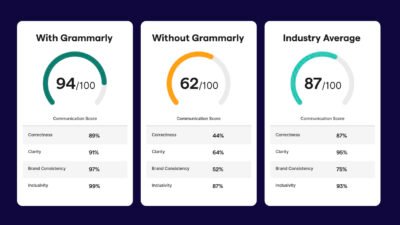
What makes this score particularly valuable is its comprehensive evaluation framework that considers:
- Message accuracy and intended meaning
- Content clarity and accessibility
- Alignment with brand voice guidelines
- Adherence to inclusive communication standards
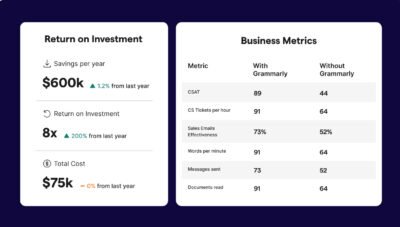
Complementing this is Grammarly’s Impact Assessment with ROI Reporting capability, perhaps one of the company’s most strategic moves to date. This tool allows prospective customers to conduct thorough A/B testing and witness firsthand the platform’s impact on their key business metrics before making any significant investment commitments.
Real Impact, Real Numbers: The Databricks Success Story
The power of these tools is perfectly illustrated by Databricks’ experience. Their implementation across a 6,000-plus workforce has delivered remarkable results: the editorial team cut editing cycles by 50%, saving an average of 15 minutes per document. Their customer support team achieved a 25% improvement in resolution time and increased case closure rates by 10-15%. The bottom line? An estimated annual savings of $1.4 million.
Measuring Success Across the Enterprise
Early adopters of Grammarly’s enterprise ROI tools have reported impressive metrics. Customer support teams have seen satisfaction scores jump by 16-20% compared to control groups. The platform has driven a 35% reduction in copy-paste actions, indicating significant workflow improvements. Teams with non-native English speakers have particularly benefited, showing measurable gains in response times and communication clarity.
Why Enterprise AI ROI Matters Now More Than Ever
The ability to quantify AI investment impact has become crucial for several reasons:
- Organizations need to justify reallocating budget from other areas to fund AI initiatives
- Companies require data-driven frameworks to identify and scale successful AI implementations while pivoting away from underperforming ones
- Early success metrics can help secure additional investment and stakeholder support
- Clear ROI measurements enable organizations to pursue more ambitious AI transformation projects
Setting the Bar for AI Impact Measurement
What distinguishes Grammarly’s approach is its commitment to demonstrable results. As noted by Luke Behnke, Head of Product for Grammarly in my recent interview, the company sees it as their responsibility to help prove the value of their tool, not just for business reasons, but to ensure customer satisfaction and understanding of the platform’s benefits.
Future Implications and Market Position
With its recent acquisition of Coda, Grammarly is positioned to expand beyond AI-powered communication into broader enterprise offerings. This strategic move, combined with their robust ROI measurement capabilities, sets them apart from competitors. Notable is the fact that neither Apple’s Writing tool, Google Gemini, nor Microsoft Copilot offer comparable ROI measurement capabilities.
Looking ahead for Grammarly, for enterprise leaders evaluating AI investments, Grammarly’s new ROI measurement tools provide a compelling framework for understanding and quantifying the impact of AI-powered communication solutions. As organizations continue adapting to remote and hybrid work environments where written communication is increasingly critical, the ability to measure and optimize communication effectiveness becomes invaluable.
The general availability of these enterprise ROI tools marks a significant milestone in enterprise AI adoption, offering organizations the data-driven insights they need to make informed decisions about their communication technology investments and demonstrate tangible operational benefits. Get more information on Grammarly’s new Effective Communication Score and ROI Report here.
See more of my coverage here:
Google Gemini Pricing Shift Signals New Phase in Enterprise AI Competition
The LogicMonitor OpenAI Alliance: an AI-Powered Evolution in Data Center Management
The AI Arms Race Intensifies: Anthropic’s Multi-Billion Dollar Backing Challenges OpenAI’s Dominance
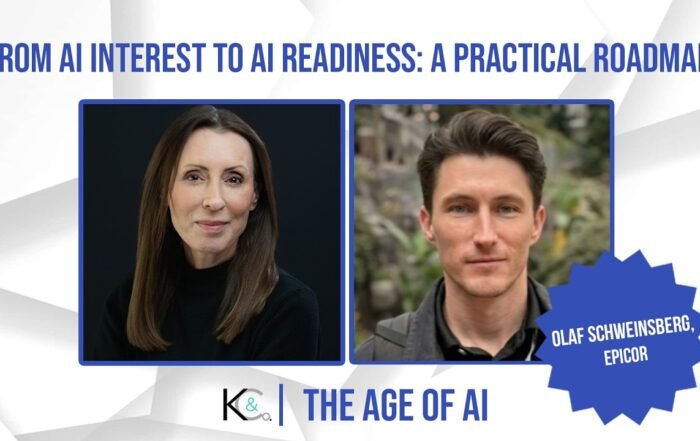
From AI Interest to AI Readiness: Inside Epicor’s Practical Roadmap for ERP Modernization
Most enterprises have already decided to pursue AI — the harder question is whether they're actually ready. Epicor Director of AI Product Management Olaf Schweinsberg joins the Age of AI podcast to unpack what readiness really requires: auditing data foundations, cleaning stale workflows, and building toward agentic capability through Prism's vertical ontology before a single agent is deployed.
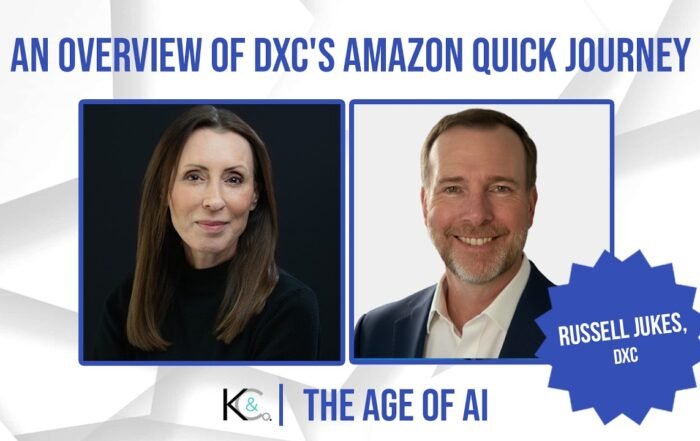
DXC’s Customer Zero Journey: Inside the Amazon Quick Rollout Powering 115,000 Employees
DXC Technology served as "customer zero" for Amazon Quick, AWS's agentic AI platform, deploying it across 115,000 employees before taking it to clients. Global CIO Russell Jukes joins the Age of AI podcast to share what co-innovation with AWS actually looked like — and why adoption metrics, agent counts, and top-down rollouts all missed the point.

Connectivity, Context, Control: Why the Data Layer—Not the Model—Decides Whether Enterprise AI Works
Frontier AI models have become good enough that the model layer is behaving like a commodity — yet fewer than 10% of enterprises say their data infrastructure is ready for AI agents. CData VP of AI Architecture Amit Naik joins the Age of AI podcast to explain why connectivity, context, and control — not model quality — determine whether enterprise AI reaches production.
Acumatica Deepens Its Vertical Bench, Acquiring Longtime Partner Vertrax
Acumatica has acquired Vertrax, a cloud-native ERP and logistics provider built specifically for fuel marketers, propane distributors, and convenience retailers. The deal converts a decade-long ISV partnership into a dedicated business unit — and signals a broader PE-backed strategy of buying vertical expertise outright rather than waiting for the ecosystem to develop it.

Citrix Platform Flex: A Smart Pivot — But Channel Partners Are Watching Closely
Citrix Platform Flex is more than a product refresh — it's a fundamental rethinking of how Citrix goes to market and where channel partners fit in. With persona-based computing, a Flex credit consumption model, Azure-native DaaS, and a restructured distribution model through Arrow Electronics, Platform Flex raises as many questions as it answers for the partner ecosystem.

When AI Gets It Wrong, Who Pays? A German Court Just Answered That Question — and Google Doesn’t Like the Answer
Germany's Regional Court of Munich has issued a landmark ruling holding Google directly liable for false and defamatory claims generated by its AI Overviews feature — claims that appeared in none of the cited sources. By treating AI-generated answers as Google's own speech, the court has set a precedent with sweeping implications for every enterprise deploying generative AI.